
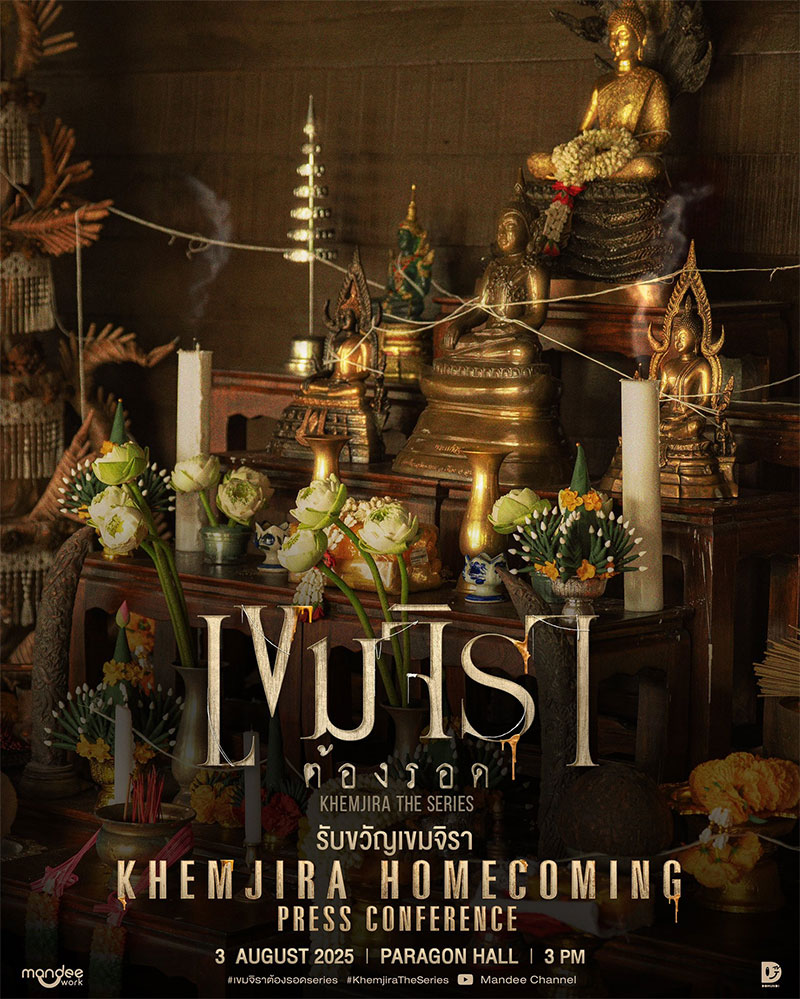
Ubon Guide is following and waiting to see what happens. Khemjira Must Survive Khemjira The SeriesEver since I found out that this novel is set in Ubon Ratchathani Province, I've been following the news.The crew and cast came to pay respect to the sacred objects and seek good fortune before starting the shoot at Wat Phra That Nong Bua and Wat Tham Wang Pha Phaya Nak Raj. They also offered a gong at Wat Sirindhorn Wararam Phu Phrao. Everyone was excited and thought that both the locations and the rituals, customs, and beliefs of the Isan people, especially those from Ubon Ratchathani, would be incorporated into the content of this series.

Recently, Guide Ubon saw a post on X (Twitter) from a user namedKiewkum @errormintRegarding the poster for this film... Since the poster was released, I personally like the "Welcome, Khemjira" poster the most. I must commend the team for their great attention to detail, even though there are no actors but just one glance and you know that this is it. Khemjira must survive.
- At the top, the Buddha image in the Naga Prok postureIt signifies the Naga lineage and is the patron deity of those born on Saturdays = Phra Kru Pharan. It also implicitly means protection from danger.
- The Buddha image in the centre is the Emerald Buddha.Buddha Statues of Ubon Ratchathani
- Number of Buddha statues on the altar Odd numbers 1-3-5 should be placed.
- The main Bai Sri offering has been left out for so long that the banana leaves have dried up. with fresh offerings to the Buddha because they are replaced for each worship
- Incense, candles, lotus flowers, vases, flower garlands, sacred threadsThat's very accurate. It looks like a shrine that has actually been used, not just a prop that has been set up.
Thank you, Khun Kiakum, for being so observant and for noticing the details of the movie poster so thoroughly. You also provided insightful information about the Buddha image in this movie poster. Guide Ubon would like to add some additional information about the Emerald Buddha and the Buddha image that are symbols of Ubon Ratchathani as follows:
It has been passed down from generation to generation that Ubon Ratchathani Province has an ancient Emerald Buddha, a symbol of the city, made from 9 types of glass, namely:DiamondGoodManiRed, bright greenEmeraldBright clear yellowbushraDark redGarnetFoggy cloud colourSapphire MukdahanHazy colour, faint redZirconNecklaceChrysolite“ Six of these ancient crystal Buddhas have already been discovered, and it is believed that there are three more, but they have not yet been found.
The 6 ancient crystal Buddhas, the symbols of Ubon Ratchathani, that have been discovered are as follows:

Emerald BuddhaWat Si Ubon Rattanaram (Royal Monastery), formerly known as Wat Si Thong, is a Dhammayuttika Nikaya temple. Located on Uparat Road, next to the Ubon Ratchathani Provincial Hall, this temple was built in 1855, the fifth year of the reign of King Rama IV of the Chakri Dynasty. The Phra Kaew Budsarakham is a Buddha image for worship in the subduing Mara posture, with a lap width of 3 inches and a height of approximately 5 inches. It is carved from solid Budsarakham crystal (yellow topaz) throughout the entire base. The Buddha image is adorned with a necklace, and the base is covered with gold. It is an ancient Buddha image, thousands of years old, crafted by artisans of the Chiang Saen school during the era of absolute monarchy.The Oath of Allegiance Ceremony was held, with the Emerald Buddha presiding over this sacred ceremony.

Emerald BuddhaWat Luang, Mueang District, Ubon Ratchathani, is a crystal Buddha image carved from natural stone that is millions of years old. No one knows who carved the stone into the Buddha image, but it has been under the custody of the Governor of Ubon for a long time. However, the ancestors of Phra Pathumworaratchasuriyawong (Chao Kham Phong) donated it as a treasure of Wat Luang along with the Crystal Buddha image made of topaz. Later, fearing that the authorities in Bangkok might forcibly take both crystal Buddha images for their personal use, they secretly hid the two images in separate locations, keeping them concealed from public knowledge.Later, when Wat Si Ubon Rattanaram (Wat Si Thong) was built by Chao Uparat Tho, the father of Phra Ubon Det Pracharak (Sue Na Ubon), the two crystal Buddhas were taken out of their hiding places. The crystal Buddha made of topaz was offered to His Holiness Phra Thewa Dhammi (Ya Thao Maw), who was the first abbot of Wat Si Thong (Wat Si Ubon Rattanaram) and a follower of the Viharn sect of King Rama IV. Civil servants who came from Bangkok They would probably have been too respectful to dare ask for the Crystal Buddha of Topaz to be taken from Ubon Ratchathani. As for the Crystal Buddha of Chrysoberyl,The heirs of the Ubon native lord kept it. Later, it was donated as the property of Wat Luang, as it remains today.

White Crystal Buddha with Dewdrop DiamondsWat Supattanaram Worawihan is a Buddha image in the meditative posture, 17 cm tall. It is made of white crystal glass. The expert is Mom Chao Phatadis Disakul. presumed that, judging from the Buddhist art, the Buddha image dates from the early Rattanakosin period. His Holiness Somdet Phra Mahaweerawong (Tisso Uan) oversaw the construction of the ubosot at Wat Supattanaram from 1917-1930 His Holiness Somdet Phra Mahaweerawong collected ancient Buddha statues in various postures from many places, such as three stone Buddha statues from the Lopburi period and many other items, especially this white crystal Buddha statue.How he came to have this Buddha image as his personal Buddha image is unclear. In 1942, His Holiness Somdet Phra Maha Wirawong (Tisso Ouan) came to reside at Wat Supattanaram and donated this sacred white crystal Buddha image as a precious treasure of Wat Supattanaram. The recipient was Phra Kru Palad Phiphattanawiriya-acharn (Nan Yanachalo).

Emerald BuddhaWat Manee Wanaram, Mueang District, Ubon Ratchathani Province, is home to an ancient Buddha image. It is sacred and highly valuable, being another important Buddha image of Ubon Ratchathani. It is made of amethyst (purple). It is considered an ancient Buddha image, along with the Crystal Buddha of Yellow Sapphire enshrined at Wat Si Ubon Rattanaram. However, the Crystal Buddha of Garnet at the temple has been well-preserved and is not displayed for the public to see and pay homage to. It was not publicised to the public. Until 1999, Phra Kru Palad Sathuwat (Saengnak Phesano, P.D.7)He became the abbot of Wat Manee Wanaram and the Chief Monk of Mueang Ubon Ratchathani District. He therefore discussed and invited the temple's laypeople to bring the Emerald Buddha to be enshrined so that the public could bathe it, pay homage to it, and worship it, thereby greatly enhancing their faith. It was decided that the event would be held on Vesak Day and has been held annually ever since.

Sapphire BuddhaWat Liab was discovered by chance on the ceiling of the Suksawas Mongkol Kut, an old kut at Wat Liab in Ubon Ratchathani Province, in 2002, or just over a decade ago, by Phra Kru Ubon Khanaporn, the current abbot of Wat Liab. When he found it, the sapphire Buddha image was enshrined in an ancient teakwood box along with two other silver Buddha images (for which a headdress and a gold crown made of genuine gemstones and gold were later crafted and offered). It was only in 2006 that the Buddha image was made available for Buddhists to pay homage to and perform the Songkran water-pouring ceremony.

Emerald BuddhaWat Liab. Phra Kru Ubonkanaporn, the abbot of Wat Liab, said that a layperson donated it. The Buddha image resembles the Emerald Buddha at Wat Pa Noi.
Buddhists can come to pay homage to and bathe these six ancient crystal Buddhas once a year. During the Songkran Festival, five crystal Buddhas are brought out for bathing: the Yellow Sapphire Crystal Buddha, the Blue Sapphire Crystal Buddha, the Garnet Crystal Buddha, the Black Sapphire Crystal Buddha, and the Emerald Crystal Buddha. The White Diamond Crystal Buddha is brought out for homage and bathing during the New Year festival, from 31 December to 2 January of the following year.